
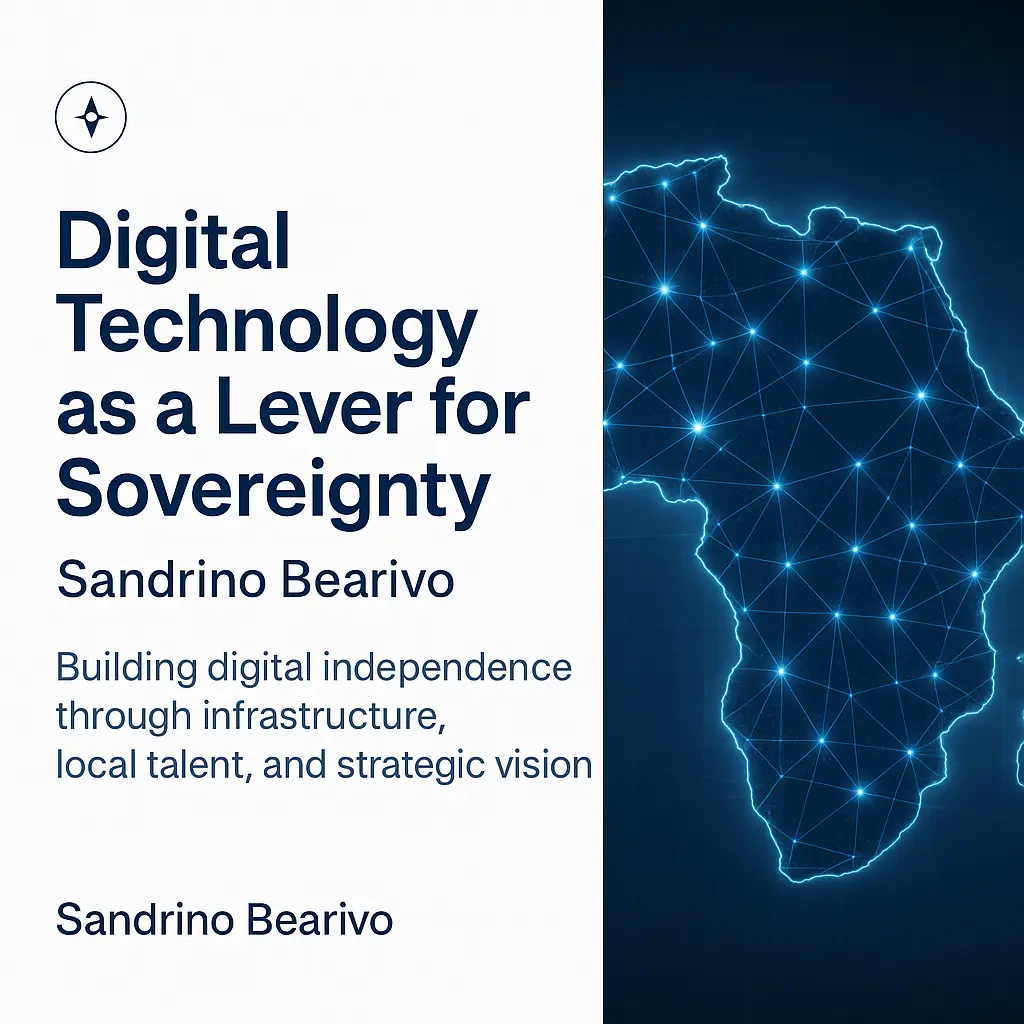
What if technological dependence were the new form of colonization?
Every day, millions of African data points travel and are stored outside the continent.
Servers, software, infrastructure, everything shaping our digital present still doesn’t belong to our territories.
What if Africa, and Madagascar in particular, wasn’t losing a technological race, but rather a part of its sovereignty?
It’s an uncomfortable question, yet a strategic one.
In the 21st century, those who control data control decisions.
And those who control decisions, control the future.
1. Digital sovereignty, an independence to reclaim
Digital sovereignty is not an abstract idea.
It is the ability of a nation to think, produce, and protect its own technologies.
It is the freedom to decide where data goes, who uses it, and for what purpose.
Many African countries are connected, but few truly control the foundations of their transformation.
They rely on foreign infrastructures, distant clouds, and technologies that often overlook their cultural or economic realities.
The result: nations connected but not sovereign, open economies but fragile foundations.
Perhaps Africa’s next revolution will not be industrial, but digital and strategic.
2. Infrastructure, the invisible foundation of power
Every click, every transaction, every decision depends on a network, on energy, on data centers.
Without mastery of these foundations, there is no sovereignty, only the illusion of modernity.
“Those who depend on others for energy cannot light their own way.”
— A modern proverb for a digital Africa.
Investing in data centers, smart grids, cybersecurity, and energy resilience is not an expense, it’s an investment in autonomy.
Through years of field experience leading large-scale projects for European and African stakeholders, Sandrino Bearivo has seen a simple truth:
when a territory hosts its data, trains its engineers, and protects its systems, it earns more than technological progress, it earns respect.
3. Local intelligence before artificial intelligence
Africa doesn’t need to copy others, it needs to create its own path.
The problem is not a lack of talent, but a lack of trust in its potential.
In Madagascar, Rwanda, and Senegal, young innovators are developing solutions deeply rooted in local realities.
Yet their ideas often fade, not for lack of creativity, but for lack of support, funding, and local structure.
Training, mentoring, and investing in local engineers, developers, and system architects is the first step toward real digital sovereignty.
It’s also the mission that Sandrino drives through Madity, his consulting firm dedicated to strategy and digital transformation, connecting global expertise with African talent.
From dependence to direction: a change of mindset
Africa doesn’t have to catch up with the world, it can redefine what progress means.
Digital sovereignty is the right to choose one’s own development model, to define how technology shapes the economy, culture, and governance.
International partnerships are essential, but they must be balanced.
True cooperation should rely on local competence, not external dependence.
This is the approach Sandrino applies when managing complex projects: combining strategic vision, disciplined execution, and the ability to unite public and private actors around a shared purpose.
5. The power of vision
The nations that will lead tomorrow are not the most connected, but the most conscious.
Those who give meaning to technology instead of being ruled by it.
“Digital sovereignty is the right to dream, to innovate, and to decide, at home.”
Madagascar has the potential to become a true digital hub in Africa, not because of its costs, but because of its intelligence, creativity, and resilience.
But it requires belief, belief that innovation can be born here, not elsewhere.
Behind every project, one conviction guides Sandrino’s work: sovereignty is not declared, it is built, project by project, team by team.
By aligning strategy, governance, and precise execution, he transforms ideas into tangible results, always serving one goal: building lasting digital independence.
Conclusion: Building to Exist
Digital transformation should never be endured, it should be chosen, consciously, strategically, collectively.
Chosen by lucid governments, by courageous leaders, and by citizens who understand that autonomy begins with knowledge.
Africa doesn’t need to be caught up, it needs to be revealed.
And it all begins with a simple idea:
To master our technology is to master our destiny.
The most meaningful transformations often begin with a conversation.
If your organization seeks to align technology, strategy, and human impact,
contact Sandrino Bearivo to build together the foundations of a strong and sustainable digital sovereignty.
